
Science • Chapter 2 • Measurement
Understanding Millimetres
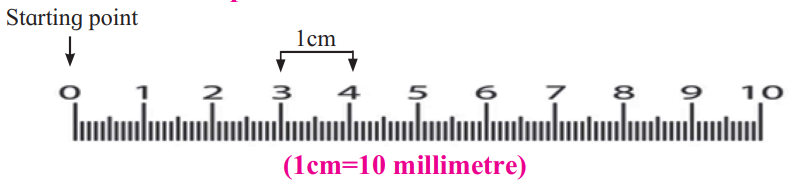
A millimetre is the tenth part of a centimetre.
Simple Explanation
1. Start with one centimetre
Think about one complete centimetre on the ruler that you observed on the previous page.
That one centimetre can be divided into smaller equal parts.
2. What does “tenth part” mean?
If one complete centimetre is divided into 10 exactly equal parts, each part is one of the ten equal parts of that centimetre.
Each such small part is called a millimetre.
3. Why is a millimetre smaller than a centimetre?
A millimetre is not the whole centimetre. It is only one of the ten equal parts into which that centimetre is divided.
The textbook diagram below shows this idea directly on a ruler.
Meanings
| Meanings | Marathi Arth | Hindi Arth |
|---|---|---|
| Millimetre — one of ten equal parts of a centimetre | मिलीमीटर | मिलीमीटर |
| Tenth part — one part when something is divided into ten equal parts | दहा समान भागांपैकी एक भाग | दस समान भागों में से एक भाग |
| Centimetre — a unit used for measuring length | सेंटीमीटर | सेंटीमीटर |
| Equal parts — parts having exactly the same size | समान भाग | समान भाग |
To measure the length of a line segment, the centimetre is a convenient unit. Whereas for measuring the length of cloth, the length and breadth of a playground metre is a more suitable unit. Since the distance between two cities is thousands of metres, a larger unit called the kilometre (km) is used to measure it. 1 km = 1000 metre
Simple Explanation
1. When is centimetre convenient?
A line segment is usually a comparatively small length.
The textbook therefore gives centimetre as a convenient unit for measuring the length of a line segment.
2. When is metre more suitable?
Some lengths are much larger than a small line segment. For these, metre is more convenient.
The textbook gives the length of cloth as one example where metre is suitable.
It also gives the length and breadth of a playground as measurements for which metre is a more suitable unit.
3. Why do we need kilometre?
The distance between two cities can be very large. Measuring such a large distance in metres would involve a very large number of metres.
Therefore, a larger unit called the kilometre is used for such distances.
The symbol for kilometre is km.
Meanings
| Meanings | Marathi Arth | Hindi Arth |
|---|---|---|
| Line segment — a part of a line having two end points | रेषाखंड | रेखाखंड |
| Convenient — easy and suitable to use | सोयीचे / योग्य | सुविधाजनक / उपयुक्त |
| Centimetre — a unit used for measuring length | सेंटीमीटर | सेंटीमीटर |
| Cloth — material used for making clothes | कापड | कपड़ा |
| Length — distance from one end to another | लांबी | लंबाई |
| Breadth — measurement from one side to the other side | रुंदी | चौड़ाई |
| Playground — an area used for playing games | खेळाचे मैदान | खेल का मैदान |
| Metre — a unit used for measuring length or distance | मीटर | मीटर |
| Suitable — right or appropriate for a purpose | योग्य | उपयुक्त |
| Thousands — many groups of one thousand | हजारो | हजारों |
| Kilometre — a larger unit used for measuring long distances | किलोमीटर | किलोमीटर |
| km — symbol used for kilometre | किलोमीटरचे चिन्ह | किलोमीटर का प्रतीक |
Accurate Measurement of Length
Understanding different instruments used to measure length and distance
You must have seen various instruments used to measure length and distance. Are the markings on the different types of measuring tapes used by cloth merchants, carpenters and surveyors the same?
Simple Explanation
1. Are all lengths measured with only one instrument?
We see different kinds of instruments being used to measure length and distance.
This tells us that there are different measuring instruments for different kinds of measuring work.
2. Think about measuring tapes used for different work
The textbook asks us to observe the measuring tapes used by different people in their work.
It particularly asks us to think about measuring tapes used by cloth merchants, carpenters and surveyors.
3. What should you observe?
Look at the markings on the different measuring tapes.
The textbook asks us to think carefully about whether the markings on all these different types of measuring tapes are the same.
Keep this question in mind. The next textbook paragraph explains the reason for the different types of markings.
Meanings
| Meanings | Marathi Arth | Hindi Arth |
|---|---|---|
| Accurate — correct and exact | अचूक | सटीक |
| Measurement — finding the length, amount or size of something | मोजमाप | मापन |
| Various — many different kinds | विविध | विभिन्न |
| Instruments — tools used for a particular purpose | उपकरणे | उपकरण |
| Length — distance from one end to another | लांबी | लंबाई |
| Distance — the space between two points or places | अंतर | दूरी |
| Markings — lines or signs made for measurement | मोजमापाच्या खुणा | माप के निशान |
| Measuring tape — a marked tape used for measuring length | मोजपट्टी / मोजण्याची टेप | मापने का फीता |
| Cloth merchant — a person who sells cloth | कापड विक्रेता | कपड़ा व्यापारी |
| Carpenter — a person who makes or repairs wooden objects | सुतार | बढ़ई |
| Surveyor — a person who measures land or distances | सर्वेक्षक | सर्वेक्षक |
Measuring tapes have convenient markings based on their requirements. It is essential to use the appropriate type of tape according to our needs.
Simple Explanation
1. Why are there different measuring tapes?
Measuring tapes are used for different types of measuring work. The kind of measurement needed in one type of work may be different from the measurement needed in another.
2. Why can their markings be different?
Measuring tapes have convenient markings according to the work for which they are needed.
This means that the markings on a measuring tape are chosen so that the tape is useful and convenient for its particular measuring requirement.
3. Can we simply choose any measuring tape?
We should select a measuring tape that is appropriate for our measuring need.
The important idea is not just to have a measuring instrument, but to choose the suitable type for the measurement that has to be made.
Meanings
| Meanings | Marathi Arth | Hindi Arth |
|---|---|---|
| Measuring tape — a marked tape used for measuring length | मोजण्याची टेप / मोजपट्टी | मापने का फीता |
| Convenient — easy and suitable to use | सोयीचे / सुविधाजनक | सुविधाजनक |
| Markings — lines or signs used for measurement | मोजमापाच्या खुणा | माप के निशान |
| Requirements — things that are needed for a purpose | गरजा / आवश्यकता | आवश्यकताएँ |
| Essential — necessary or very important | आवश्यक | आवश्यक |
| Appropriate — correct or suitable for a particular purpose | योग्य | उपयुक्त |
| According to — based on or depending on | त्यानुसार / प्रमाणे | के अनुसार |
| Needs — things that are required | गरजा | ज़रूरतें |
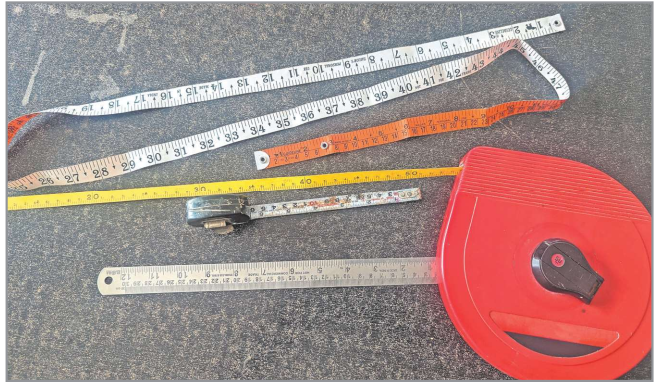
A ruler is necessary to measure the distance between any two points. To measure the length of a piece of chalk a ruler of 15 cm is perfect. To measure the height of a door, a metre scale or a measuring tape will be required; however, to measure the circumference of objects with curved surfaces, we must use the flexible measuring tape (tailor’s tape).
Simple Explanation
1. Measuring the distance between two points
A ruler can be used when we want to measure the distance between two points.
The ruler gives us fixed markings that help us find the distance from one point to the other.
2. Measuring a piece of chalk
A piece of chalk is a small object. The textbook says that a 15 cm ruler is suitable for measuring its length.
We do not need a very long measuring instrument for such a small object.
3. Measuring the height of a door
A door is much longer than a small piece of chalk. A short 15 cm ruler is therefore not the convenient choice mentioned for this measurement.
The textbook tells us to use a metre scale or a measuring tape to measure the height of a door.
4. Measuring around a curved object
Some objects have curved surfaces. Here we may need to measure the distance around the object. This distance around it is called its circumference.
For such a measurement, the textbook tells us to use a flexible measuring tape, also called a tailor's tape.
Because this tape is flexible, it can follow the curved surface of the object while the measurement is taken.
Meanings
| Meanings | Marathi Arth | Hindi Arth |
|---|---|---|
| Ruler — an instrument used for measuring length | मोजपट्टी | मापनी / पैमाना |
| Necessary — needed for a particular purpose | आवश्यक | आवश्यक |
| Points — exact positions or places | बिंदू | बिंदु |
| Piece of chalk — a small piece of chalk used for writing | खडूचा तुकडा | चॉक का टुकड़ा |
| Metre scale — a scale used for measuring length in metres | मीटर पट्टी | मीटर मापनी |
| Measuring tape — a marked tape used for measuring length | मोजण्याची टेप | मापने का फीता |
| Required — needed | आवश्यक असलेले | आवश्यक |
| Circumference — the distance around an object | परिघ | परिधि |
| Curved surface — a surface that bends and is not flat | वक्र पृष्ठभाग | वक्र सतह |
| Flexible — able to bend easily | लवचिक | लचीला |
| Tailor's tape — a flexible measuring tape used for taking measurements | शिंप्याची मोजपट्टी | दर्जी का मापने वाला फीता |
Some Important Points for Measuring the Accurate Length
* The object whose length is to be measured must be in direct contact with the
ruler.
* The ruler should be held such that its starting point (the 0 mark) aligns with the
beginning edge of the object.
* While measuring the distance between two points, place the starting point of the
scale on the first point and observe which mark on the scale aligns with the
second point.
Simple Explanation
1. Keep the object in direct contact with the ruler
The object whose length we want to measure should be placed directly against the ruler.
The object and ruler should not be separated from each other while the measurement is being taken.
2. Align the starting edge with the 0 mark
Look for the 0 mark on the ruler. This is the starting point of the scale.
Place the ruler so that the 0 mark is exactly in line with the beginning edge of the object.
In simple words, the object's beginning and the ruler's starting point should be together.
3. Measuring the distance between two points
Suppose we want to measure the distance between a first point and a second point.
Place the starting point of the scale exactly on the first point.
Now look at the second point and observe which ruler marking is exactly in line with it.
That marking helps us find the distance from the first point to the second point.
Meanings
| Meanings | Marathi Arth | Hindi Arth |
|---|---|---|
| Accurate — correct and exact | अचूक | सटीक |
| Position — the place or way in which something is kept | स्थिती / स्थान | स्थिति / स्थान |
| Direct contact — touching directly without a gap | थेट संपर्क | सीधा संपर्क |
| Ruler — an instrument used for measuring length | मोजपट्टी | मापनी / पैमाना |
| Starting point — the point from where measurement begins | सुरुवातीचा बिंदू | प्रारंभिक बिंदु |
| 0 mark — the zero marking from where measurement starts | शून्याची खूण | शून्य का निशान |
| Aligns — comes exactly in the same line or position | एका रेषेत येते | एक सीध में आता है |
| Beginning edge — the edge from where the object starts | सुरुवातीची कड | शुरुआती किनारा |
| Scale — a marked instrument used to measure length | मोजपट्टी | मापनी |
| Observe — look at something carefully | निरीक्षण करणे | ध्यान से देखना |
| Second point — the other point up to which distance is measured | दुसरा बिंदू | दूसरा बिंदु |