
Science • Chapter 2 • Measurement
Ways of Measuring Length

Textbook Paragraph
Measure the length of your school desk or table using your hand span and finger-width. Ask your friends, siblings, or parents to measure the same distance. Is everyone’s measurement the same?
💡 Simple Explanation
First, measure the length of your school desk or table using your hand span and finger-width.
A hand span is the distance between the tip of the thumb and the tip of the little finger when the hand is fully opened.
Finger-width means using the width of a finger as a unit for measuring length.
Ask your friends, brothers, sisters or parents to measure the same desk or table in the same way.
Compare everyone’s answers. The measurements may not be the same because the size of each person’s hand and fingers can be different.
📚 Meanings
| Meanings | Marathi Arth | Hindi Arth |
|---|---|---|
| Length — the distance from one end of something to the other end | लांबी | लंबाई |
| School desk — a table used by students at school | शाळेतील बाक / टेबल | विद्यालय की मेज़ |
| Hand span — the distance between the thumb and little finger of an open hand | वीत | बालिश्त |
| Finger-width — the width of a finger used for measuring | अंगुल | अंगुल |
| Friends — people whom we know and like | मित्र | मित्र |
| Siblings — brothers and sisters | भावंडे | भाई-बहन |
| Parents — mother and father | आई-वडील / पालक | माता-पिता / अभिभावक |
| Same distance — an equal length measured by everyone | समान अंतर | समान दूरी |
| Measurement — the result obtained after measuring something | मोजमाप | माप |
Textbook Paragraph
In the past, units like finger-width (angul), fist (mushti), hand span (hasta) and footstep were used to measure length. However, because age, body sizes vary, the measurements taken by different people also vary. This is called ‘Non-standard measurement’.
💡 Simple Explanation
In earlier times, people used parts of their bodies as units for measuring length.
They used finger-width, called angul; the fist, called mushti; hand span, called hasta; and footsteps.
The age and body size of every person are not the same. Therefore, their fingers, fists, hands and footsteps can have different sizes.
When different people measure the same length using these body-based units, their answers may be different.
Such units do not have one fixed size for everyone. Therefore, this way of measuring is called Non-standard measurement.
📚 Meanings
| Meanings | Marathi Arth | Hindi Arth |
|---|---|---|
| In the past — in earlier times | पूर्वीच्या काळात | पुराने समय में |
| Units — fixed quantities used for measuring | एकके | इकाइयाँ |
| Finger-width — the width of a finger used for measurement | अंगुल | अंगुल |
| Fist — a tightly closed hand | मूठ / मुष्टी | मुट्ठी |
| Hand span — the distance between the thumb and little finger of an open hand | वीत / हस्त | बालिश्त / हस्त |
| Footstep — the distance covered by one step | पाऊल | कदम |
| However — used to show a different or opposite point | तथापि / परंतु | हालाँकि / परंतु |
| Body sizes — the sizes of different people’s bodies | शरीराचे आकार | शरीर के आकार |
| Vary — to be different | बदलणे / वेगवेगळे असणे | अलग-अलग होना |
| Non-standard measurement — measurement made using units that are not fixed | अप्रमाणित मोजमाप | अमानक मापन |
Textbook Paragraph
Instead, if everyone uses a fixed unit, the measurement remains the same regardless of who measures it. This system is known as ‘Standard measurement.’ For example, if you buy one metre of cloth from a shop where it is measured with a metre scale and your grandfather measures it again at home with his metre scale, will the measurements be the same or different?
Standard Measurement
Measurement made using a fixed unit that gives the same result for everyone is called standard measurement.
💡 Simple Explanation
To avoid different answers, everyone should use the same fixed unit for measuring.
A fixed unit does not change from one person to another. Therefore, the measurement remains the same whoever measures it.
This method of using fixed units is called Standard measurement.
A metre scale has one fixed length. A metre scale used in a shop and a metre scale used at home represent the same unit.
Therefore, one metre of cloth measured by the shopkeeper should have the same measurement when it is measured again at home using another correct metre scale.
📚 Meanings
| Meanings | Marathi Arth | Hindi Arth |
|---|---|---|
| Instead — in place of something else | त्याऐवजी | इसके बजाय |
| Fixed unit — a measuring unit whose value does not change | निश्चित एकक | निश्चित इकाई |
| Remains — continues to be the same | कायम राहते | बना रहता है |
| Regardless — without being affected by a particular condition | विचार न करता | परवाह किए बिना |
| System — an organized method of doing something | पद्धती / प्रणाली | प्रणाली |
| Standard measurement — measurement made using fixed and accepted units | प्रमाणित मोजमाप | मानक मापन |
| Metre — a standard unit used to measure length | मीटर | मीटर |
| Metre scale — a measuring scale that is one metre long | मीटरपट्टी | मीटर मापनी |
| Measured — found the size or amount of something | मोजलेले | मापा गया |
| Different — not the same | वेगळे | अलग |
Do You Know?
In ancient Egypt, the distance from a person’s elbow to the tip of the middle finger was used as a unit of length called a Cubit. Since this varied from person to person, the King’s cubit was established as the Royal Cubit. The Romans had their own version of the cubit, divided into two feet. Each foot was divided into twelve equal parts called inches. For long distances, they used a unit called mille passus (meaning one thousand paces). The distance we call a mile today is slightly more than that.
Simple Explanation
1. What was a Cubit in ancient Egypt?
In ancient Egypt, people used a part of the human arm for measuring length.
The distance from a person's elbow to the tip of the middle finger was taken as one unit of length. This unit was called a Cubit.
2. Why did the Cubit create a problem?
Every person's arm is not exactly the same length. One person may have a longer arm while another person may have a shorter arm.
Therefore, the distance from the elbow to the middle fingertip could also be different from person to person.
This means that if everyone used his or her own Cubit, different people could get different measurements for the same length.
3. What was the Royal Cubit?
A fixed reference was needed so that the Cubit would not keep changing from person to person.
The King's Cubit was therefore established as the Royal Cubit.
The important difference is that an ordinary Cubit could vary because different people's arms were different. The Royal Cubit provided one decided Cubit to use as the reference.
4. Now the paragraph moves from Egypt to the Romans
The next part is about the Romans. The Romans had their own version of the Cubit.
In the system described in your textbook, their Cubit was divided into two feet.
Here, foot means a unit of length. Do not imagine two actual human feet physically joined together.
To understand “two feet”, imagine one foot-unit placed first. Exactly where that first foot-unit ends, the second foot-unit begins. The two equal length-units are therefore placed end-to-end.
The second foot-unit begins where the first foot-unit ends. Together they show the two foot-units described in the textbook.
5. How do we get inches from a foot?
Now look at only one foot-unit.
The Romans divided each foot into 12 equal parts.
Each one of these twelve equal small parts was called an inch.
Therefore, the relationship is easy to understand: one foot contains 12 inches.
6. What was Mille Passus?
The paragraph now changes from these smaller units of length to the measurement of long distances.
For long distances, the Romans used a unit called mille passus.
It is pronounced approximately “MEE-leh PAS-soos.”
Mille passus means one thousand Roman paces.
What does a Roman pace mean?
The Roman pace or passus should not be confused with just one ordinary single step.
A Roman passus was approximately one complete stride, which contains two ordinary steps.
To picture it simply, imagine the right foot at a starting position. Take one step forward with the left foot and then another step forward with the right foot. The right foot has now moved forward to a new position. This complete movement represents approximately one Roman pace or passus.
The Romans counted such complete paces along a long distance. When 1,000 Roman paces were counted, the distance was called mille passus.
7. Is Mille Passus connected to the inch?
No. This distinction is very important.
In the paragraph, Cubit, foot and inch form one group of connected measurements.
Mille passus is introduced separately as a unit used for long distances.
Therefore, do not think that an inch is divided into paces or that mille passus is the next small division after an inch. They are different measurement ideas.
8. What is the connection between Mille Passus and today's Mile?
The final sentence compares the old Roman mille passus with the mile that we know today.
The textbook tells us that today's mile is slightly more than the old mille passus distance.
“Slightly more” means that the distance of a mile today is a little longer than the old mille passus distance.
Do Not Mix These Two Ideas
One-Look Revision
Meanings
| Meanings | Marathi Arth | Hindi Arth |
|---|---|---|
| Ancient — belonging to a very old time | प्राचीन | प्राचीन |
| Elbow — the joint in the middle of the arm | कोपर | कोहनी |
| Tip — the end point of something | टोक | सिरा |
| Cubit — an old unit based on the distance from the elbow to the middle fingertip | क्युबिट / प्राचीन लांबीचे एकक | क्यूबिट / प्राचीन लंबाई की इकाई |
| Varied — was different from person to person | वेगवेगळे होते | अलग-अलग था |
| Established — fixed or decided for use | निश्चित केले | निश्चित किया |
| Royal Cubit — the King's Cubit established as the reference | राजकीय क्युबिट | राजकीय क्यूबिट |
| Romans — people of ancient Rome | प्राचीन रोमचे लोक | प्राचीन रोम के लोग |
| Foot — a unit of length used in the measurement system described here | फूट / लांबीचे एकक | फुट / लंबाई की इकाई |
| Equal parts — parts having the same size | समान भाग | समान भाग |
| Inch — one of twelve equal parts of a foot | इंच | इंच |
| Long distance — a large distance from one place to another | लांब अंतर | लंबी दूरी |
| Pace — in this Roman measurement, approximately one complete stride | पूर्ण पाऊल टाकण्याचे अंतर | एक पूरी चाल का अंतर |
| Stride — the distance covered by a complete walking movement of two steps | दोन पावलांची पूर्ण चाल | दो कदमों की पूरी चाल |
| Mille passus — a Roman long-distance unit meaning one thousand paces | एक हजार पावलांच्या चालींचे रोमन अंतर एकक | एक हजार चालों की रोमन दूरी की इकाई |
| Mile — a unit used for measuring long distances | मैल | मील |
| Slightly — by a small amount | थोडेसे | थोड़ा-सा |
Standard Measurement
Standard Measurement- Earlier, different regions used different instruments and units to measure distance, grains and liquids. This caused significant difficulties in trade and other daily tasks. To solve this, a uniform system of measuring instruments and units was established for everyone. This is known as the Standard System or the International System of Units (SI Units).
Simple Explanation
1. What was different in different regions?
Different regions used different instruments and different units for measurement. These were used for measuring things such as distance, grains and liquids.
2. Why did this become a problem?
If people in different places used different measuring units, a measurement understood in one region might not be the same measurement used in another region. This created difficulties, especially in trade and everyday work.
3. What was needed to remove this difficulty?
People needed a uniform system. Uniform means the same system could be followed by everyone instead of every region having its own different way of measuring.
4. What was made uniform?
Both the measuring instruments and the units of measurement needed to follow a common system. In this way, people could understand measurements in the same manner.
5. What is the Standard System?
The uniform system of measuring instruments and units established for everyone is called the Standard System.
6. What are SI Units?
The textbook also gives the name International System of Units for this standard system. Its shortened name is SI Units.
Therefore, when you see SI in this lesson, remember that it refers to the International System of Units.
The Standard System or International System of Units (SI Units) provides a common system of measurement for everyone.
One-Look Revision
Different regions: Different measuring instruments and units.
Problem: Difficulties in trade and daily tasks.
Solution: One uniform system for everyone.
Name: Standard System.
International name: International System of Units.
Short form: SI Units.
Meanings
| Meanings | Marathi Arth | Hindi Arth |
|---|---|---|
| Earlier — in the time before now | पूर्वी | पहले |
| Regions — different areas or parts of a place | प्रदेश / विभाग | क्षेत्र / प्रदेश |
| Instruments — tools used for a particular work | उपकरणे | उपकरण |
| Units — fixed quantities used for measurement | एकके | इकाइयाँ |
| Distance — the space between two points or places | अंतर | दूरी |
| Grains — seeds of crops used as food | धान्य | अनाज |
| Liquids — substances that can flow | द्रव पदार्थ | तरल पदार्थ |
| Significant — important or considerable | लक्षणीय / महत्त्वपूर्ण | महत्त्वपूर्ण |
| Difficulties — problems that make something harder | अडचणी | कठिनाइयाँ |
| Trade — buying and selling of goods | व्यापार | व्यापार |
| Uniform — the same for everyone | एकसमान | एकसमान |
| Established — officially set up or decided | स्थापित केले | स्थापित किया |
| Standard System — a common accepted system of measurement | प्रमाणित मापन प्रणाली | मानक मापन प्रणाली |
| International — accepted or connected across different countries | आंतरराष्ट्रीय | अंतरराष्ट्रीय |
| International System of Units (SI Units) — the standard system of measurement units | आंतरराष्ट्रीय एकक पद्धती | अंतरराष्ट्रीय इकाई प्रणाली |
International System of Units (SI Units)
International System of Units (SI Units). If one metre of distance is divided into 100 equal parts, each part is called a centimetre (cm). 1 metre = 100 centimetres
Simple Explanation
1. Begin with one complete metre
Take a length of one metre. We want to divide this complete metre into smaller, equal parts.
2. Divide one metre into 100 equal parts
One metre is divided into 100 parts of exactly the same length. “Equal parts” means that no part is longer or shorter than another.
3. What is each part called?
Each one of these 100 equal parts is called one centimetre.
4. What does cm mean?
cm is the symbol used for centimetre.
Meanings
| Meanings | Marathi Arth | Hindi Arth |
|---|---|---|
| Metre — a unit used for measuring length or distance | मीटर | मीटर |
| Distance — the length or space between two points | अंतर | दूरी |
| Divided — separated into smaller parts | विभागलेले | विभाजित |
| Equal parts — parts having the same size | समान भाग | समान भाग |
| Centimetre — one of 100 equal parts of a metre | सेंटीमीटर | सेंटीमीटर |
| cm — symbol used for centimetre | सेंटीमीटरचे चिन्ह | सेंटीमीटर का प्रतीक |
Measurement, Unit and Symbol
| Measurement | Unit | Symbol |
|---|---|---|
| Length / Distance | Metre | m |
| Mass | Kilogram | kg |
| Time | Second | s |
Observe the Ruler Carefully
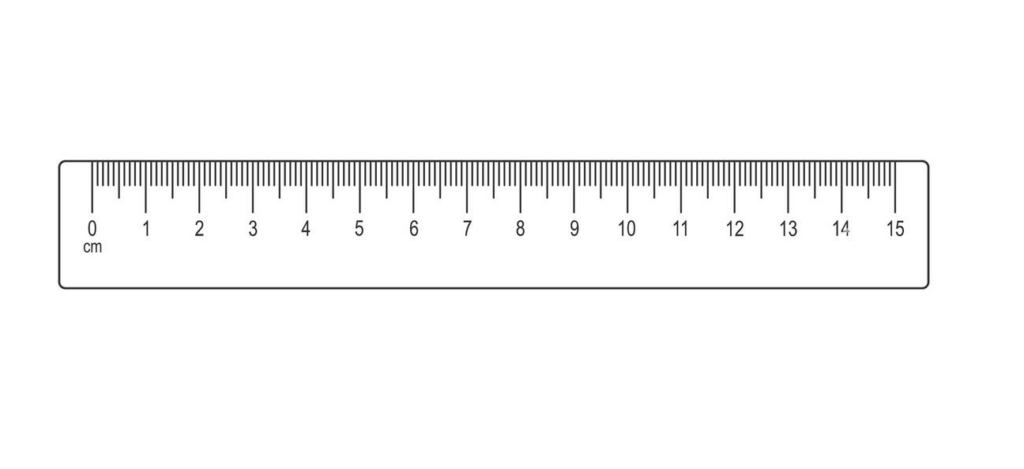
Observe the 15 cm ruler in your compass box.
Simple Explanation
Take the 15 cm ruler that you normally keep in your compass box and look at it carefully.
Do not only look at the ruler as a whole. Pay attention to the numbers and the different markings made on it. The next part of the lesson explains what these markings mean.
Meanings
| Meanings | Marathi Arth | Hindi Arth |
|---|---|---|
| Observe — look at something carefully | निरीक्षण करणे / काळजीपूर्वक पाहणे | निरीक्षण करना / ध्यान से देखना |
| Ruler — an instrument used for measuring length | मोजपट्टी | मापनी / पैमाना |
| 15 cm ruler — a ruler marked up to 15 centimetres | १५ सेंटीमीटरची मोजपट्टी | १५ सेंटीमीटर की मापनी |
| Compass box — a box used for keeping mathematical instruments | कंपास पेटी | ज्यामिति बॉक्स / कंपास बॉक्स |
Understanding the 15 cm Ruler
Observe the 15 cm ruler in your compass box. You will see markings from 0 to 15. The distance between two big markings is 1 cm. Each centimetre is further divided into ten small parts. Each of these small parts is called a millimetre (mm).
Simple Explanation
1. What do the numbers 0 to 15 show?
On the 15 cm ruler, you can see numbered positions beginning with 0 and continuing up to 15.
These numbers help us locate the centimetre positions on the ruler.
2. What is one centimetre on the ruler?
Look at the large marking at 0 and then at the next large marking at 1.
The distance between these two markings is one centimetre.
Marking and distance are not the same thing
The thin line printed on the ruler is a marking.
The space or distance from one marking to the next marking is what gives us the measurement.
Therefore, when we say “1 cm”, we mean the distance between two neighbouring centimetre markings.
3. Now look between two centimetre markings
Look closely between 0 cm and 1 cm on your uploaded ruler. You will notice smaller markings between the two large centimetre positions.
The complete distance of 1 centimetre is divided into 10 equal small parts.
“Equal” means that all ten small parts represent the same amount of length.
4. What exactly should we count?
The important thing is the small spaces or intervals between the markings.
From one centimetre position to the next centimetre position, the full 1 cm distance contains 10 equal small intervals.
This prevents an easy mistake: students sometimes count only the little printed lines instead of looking at the equal distances between the markings.
5. What is one small part called?
Each one of these ten equal small parts is called one millimetre.
The short symbol for millimetre is mm.
Therefore, when one centimetre is divided into ten equal parts, each individual part measures one millimetre.
6. How are centimetre and millimetre connected?
We begin with one complete centimetre.
That one centimetre contains ten equal millimetre parts. Therefore:
So, 1 cm is not 1 mm. One complete centimetre contains 10 millimetres.
One-Look Revision
Meanings
| Meanings | Marathi Arth | Hindi Arth |
|---|---|---|
| Markings — lines made at measured positions | मोजमापाच्या खुणा / रेषा | माप के निशान / रेखाएँ |
| Distance — the space or length between two points | अंतर | दूरी |
| Centimetre — a unit used for measuring length | सेंटीमीटर | सेंटीमीटर |
| cm — the symbol for centimetre | सेंटीमीटरचे चिन्ह | सेंटीमीटर का प्रतीक |
| Further divided — divided again into smaller parts | पुढे आणखी विभागलेले | आगे और विभाजित |
| Equal parts — parts having the same size | समान भाग | समान भाग |
| Interval — the space between two markings | दोन खुणांमधील अंतर | दो निशानों के बीच का अंतर |
| Millimetre — one of ten equal parts of a centimetre | मिलीमीटर | मिलीमीटर |
| mm — the symbol for millimetre | मिलीमीटरचे चिन्ह | मिलीमीटर का प्रतीक |